

A different way of working with problems that have not resolved
At In The Clear in Tunbridge Wells, we use the Boulderstone Technique — a hands-on approach developed through clinical practice.
People come to us for many different reasons: general health issues; allergies and sensitivities; emotional difficulties including anxiety, trauma and overwhelm.
The problems may look very different, but our starting question is the same:
What is preventing the person from returning naturally to a settled state?
What brings people to us?
General Health
People come with a general feeling of ill health, persistent pain, fatigue, symptoms following injury and other physical difficulties that have not resolved.
Allergies and Sensitivities
A substantial part of our clinic work is with people who believe they are reacting to foods, environmental substances or other triggers.
Trauma, Overwhelm and Emotional Difficulties
People come to us with difficulties including anxiety, panic, phobias, compulsions, unresolved grief, overwhelm and post-traumatic reactions.
Detailed retelling is not normally required.
Read more about trauma, overwhelm and emotional difficulties
Multiple Sclerosis
John has a particular clinical interest in working with people who have multiple sclerosis, based on observations developed through clinical practice.
What happens in a session?
We begin with a short conversation about what you would like help with.
You then lie fully clothed on a treatment couch. With your permission, the practitioner normally makes gentle contact with your head.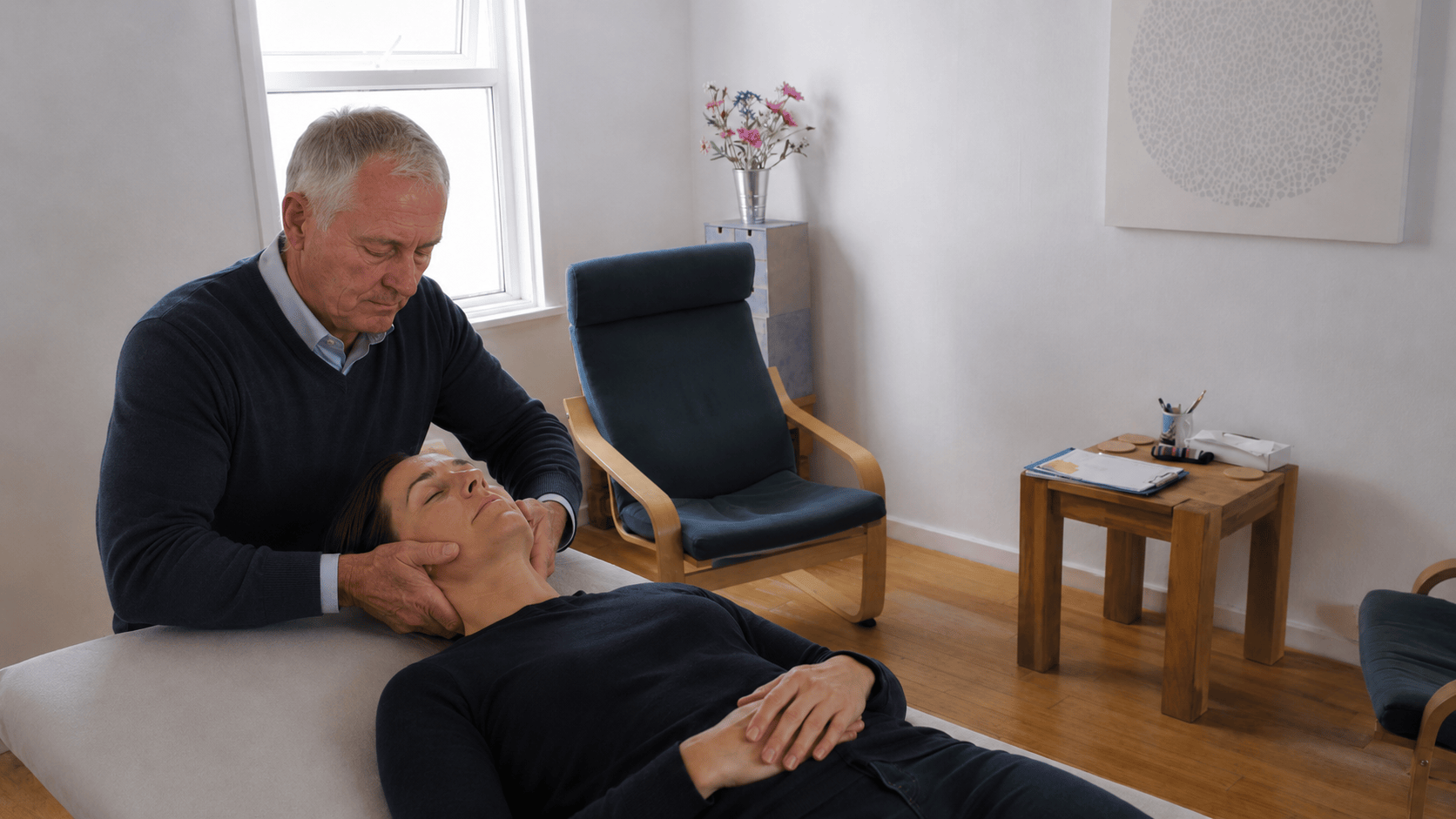
There is no manipulation and no movement is forced.
For the allergy test, a number of vials containing different substances are placed in turn on you to assess the reaction
For emotional or trauma-related work, we may briefly bring the problem into awareness and then remove it again once a response begins. The aim is to work without pushing you into overwhelm.
The practitioner pays attention to the changing response that is felt through the contact and follows it as it develops.
You can speak, pause or stop at any point.
We aim to keep appointments quiet, straightforward and unhurried, particularly for people who may already feel anxious, exhausted or overwhelmed.
At the end of the session, we allow time for things to settle and discuss what, if anything, should happen next.
What is the Boulderstone Technique?
The Boulderstone Technique is based around a state we call the still point.
The still point is not simply relaxation. It is a state of peace in which there is no sense of inner tension or stress demanding attention — a state that, within the Boulderstone Technique, we associate with health.
When something difficult or unresolved is present, there is a movement away from that state. In my experience, the earliest sign can sometimes be what I can only describe as an energetic impulse, followed almost immediately by a physical response — tightening, bracing or shrinking away. Only afterwards do we experience and describe what is happening emotionally and mentally, and later still put it into words. It is that physical tension that tells us there is a problem.
This is why the Boulderstone Technique is hands-on. The problem is not being translated into the body; within this clinical model, the physical response is already there.
Rather than trying to suppress, correct or force that response to change, the practitioner allows it to complete, staying focused and avoiding overwhelm. The movement may at times be strong, but it is usually easy if it is allowed to happen. It is continuous and changing, is not imposed on you, and you do not have to make it happen. Detailed talking is not required.
When the movement comes to an end, there is a return to still point.
This is the clinical framework through which we understand what is happening in the person. It has developed through practice and observation over many years.
About John and Katharine
In The Clear is a small clinic in Tunbridge Wells.
John Boulderstone first discovered the Boulderstone Technique in 1995. His earlier training and practice included homeopathy and craniosacral therapy. Together with his wife Katharine Boulderstone (also a homeopath), they have developed and refined the technique over many years of clinical practice.
Library – Books, Comics, Articles
If you would like to understand more about the ideas behind the work, there are several ways to explore them before making an appointment.
The Still Point and the Dance
John’s book about the development of the ideas behind the Boulderstone Technique.
PTSD Detective
A comic-book explanation of trauma and the way we work with it.
In The Clear
A comic-book explaining how the clinic came into existence, allergy and the still point.
Articles and papers
Longer writing, including clinical and scientific papers and articles exploring the ideas in greater depth.
Thinking about coming to see us?
You do not need to decide whether the Boulderstone Technique is right for you before contacting us.
If you are unsure, tell us briefly what is happening and we can explain whether what we do seems relevant.
In The Clear
Tunbridge Wells, Kent
An important note
The Boulderstone Technique is an alternative approach. It does not replace medical assessment, emergency treatment, neurological or allergy specialist care, or prescribed medication.
If you have a diagnosed medical condition, or symptoms that require medical investigation, we encourage you to remain under the care of the appropriate healthcare professional.
We work with people, not diagnosed conditions.